7. Requirements on the absorbent
Preparation of the absorbent
The absorbents must fulfil certain requirements in order to show
a satisfactory, purifying action.
Alongside the requirements already
mentioned concerning the iron content and the chemical composition, the
following are important:
Bulk density
The absorbent must not be too "dense", that is it should possess
a certain empty or pore volume. If the absorbent is too fine, the gas flow will
be hindered. The resistance pressure in the layers and, thus, in the chamber
will be too great. In extreme cases the purification chamber can become blocked.
Grinding, stamping
The absorbent material will normally be found in the form of
soil or as lumps which should be broken up and ground. Stamping with an
appropriate tool is a suitable technique.
Comminution increases the surface area (important for the
chemical reaction) and secondly, the crystal structure is improved.
Filler
To obtain the desired porosity, a filler is mixed into the
ferrous material. Organic fillers are suitable. They loosen the texture of the
absorbent and bind a certain amount of water into it.
Suitable fillers are:
Sawdust or fine woodshavings, milled
straw, chaff, fine peat, milled coconut fibre and similar substances.
A
mixture with the ferrous material containing 10-15% filler is to be obtained.
Water is added while mixing so that the finished mixture has a moisture content
of 20-30%.
The finished absorbent
The addition of water and the filler should transform the
original powdery, ferrous material into a friable, crumbly mass. It should not
smear if rubbed in the hand, but should also not pulverize for lack of water.
Bulk density
The bulk density, which is a measure of the porosity, should be
0.7 - 0.8 kg/litre.
The bulk density can be measured by taking a tin can, for
example, with a known volume, filling it loosely with absorbent and weighing it.
The absorbent should not be packed down or pressed - but exactly as it is in the
purification chamber.
Particle size
The particle size should be from 2 to 5 mm.
pH value
The finished absorbent should have a pH of at least 5. A slight
alkalinity is better. If the natural soil is acidic due to humic acid or the
filler is acidic (peat especially), then the absorbent can be neutralized by the
addition of alkaline material.
The pH value can be adjusted with soda or potash. About 2 to 4%
is added to the absorbent. As a substitute alkaline wood or plant ash could also
be used.
This treatment, however, is not expected to be as effective as
guaranteeing the optimal particle size and porosity.
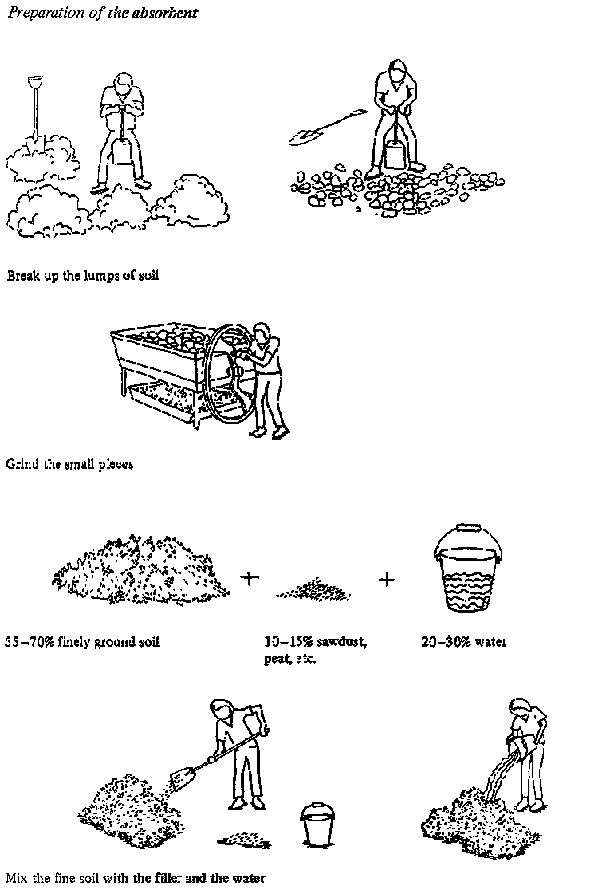
Preparation of the
absorbent